What if everything we think we know about the universe’s beginning is just one chapter in a story that never truly began—and will never truly end?
The prevailing scientific model, the Big Bang, describes the universe as having originated from a single, dense point roughly 13.8 billion years ago. The evidence for this includes the expansion of space (Hubble’s Law), the cosmic microwave background (CMB), and the observed abundance of light elements. It’s a well-supported framework—but what if it doesn’t tell the whole story?
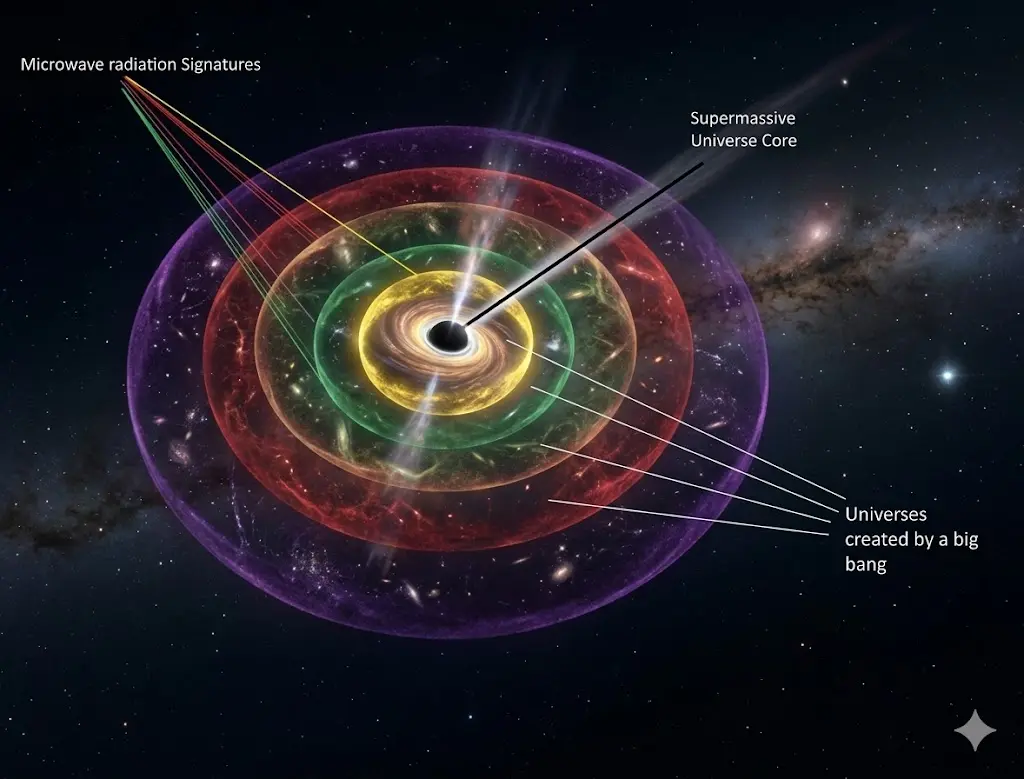
The Multi-Bang Hypothesis suggests that the Big Bang wasn’t the beginning of everything, but rather one of many cosmic eruptions. In this view, what we call “the universe” refers only to the space where our stars exist. The age we assign to the universe—based on the CMB and other observations—is actually just the age of this particular region of spacetime.
Imagine a far larger cosmos populated by supermassive, energetic objects—possibly quasars or something unknown—that eventually explode in events powerful enough to create entirely new regions of spacetime. These “bangs” could function as localized creation events, each giving rise to its own stars, galaxies, and background radiation. Our Big Bang would then be just one among many.
This hypothesis also reframes the CMB. Instead of being the leftover radiation from a singular beginning, it could be the thermal signature of the most recent bang that created our observable region. If so, other cosmic microwave backgrounds might exist beyond our observational limits, each associated with a different bang.
The Multi-Bang Hypothesis doesn’t contradict current cosmological observations—it offers an alternate interpretation. It imagines a universe that is not a one-time event, but an ongoing, fragmented process of creation. Each bang would be like a spark in the dark, lighting up a new corner of a vast, unseen reality.
Can It Be Tested?
Testing the Multi-Bang Hypothesis would require identifying signals or structures beyond our current observational horizon. One possibility might involve searching for anomalies in the cosmic microwave background—regions that suggest interaction with a different background or evidence of a boundary with another “bang zone.” Another approach could involve developing gravitational wave detectors sensitive enough to detect relic signals from older, non-local events—if such signals could propagate across bangs. In principle, unusual patterns in the large-scale structure of the universe might hint at influences from other cosmic regions. Any evidence of a second, distinct CMB would be especially compelling.
Additionally, there may be a more tangible, though extremely rare, opportunity: an interstellar or intergalactic object passing through our solar system from a region beyond our known universe. If such an object could be captured and analyzed, and if it were found to contain heavy elements that couldn’t have been produced by any known stellar process in our own cosmic history, it might suggest that it originated from a different “bang”—a region with its own nuclear history. Such a discovery would imply that either our universe is much older than we think, or that other bangs are not only real but occasionally interact with or overlap our own.

Leave a Reply