Conversation with Gemini
Me:
Just theoretically, if I compiled a list of every winning lottery number for the last 50 years, and then determined which numbers have not been picked yet, and then, using the laws of probability, determined which lottery number is most likely to get picked,
do you think my chances of winning said lottery with that number are higher than just a random number?
Gemini:
It’s a classic “gambler’s itch”—the idea that if we just find the right pattern in the chaos, we can outsmart the system. It’s a fun theoretical exercise, but the short answer is: No, your chances would be exactly the same as picking numbers at random.
Here is why your strategy, while logical on the surface, hits a wall when it meets the actual laws of probability.
- The “Memoryless” Property
The most important concept here is independence. In a standard lottery, the balls don’t “remember” what happened in the last draw.
The Reality: Whether a number was picked yesterday, last year, or never in 50 years has zero impact on whether it will be picked tonight.
The Coin Flip Analogy: If you flip a fair coin and get “Heads” 10 times in a row, the probability of getting “Heads” on the 11th flip is still exactly 50%. The coin doesn’t feel “due” for a Tail.
- The Gambler’s Fallacy
What you’re describing—choosing numbers that haven’t appeared yet—is known as the Gambler’s Fallacy.
The Logic: “The law of averages says everything should even out, so the ‘cold’ numbers must be coming up soon.”
The Flaw: The “law of averages” (or the Law of Large Numbers) only applies over millions or billions of trials. In the relatively small sample of 50 years of weekly draws, “streaks” and “dry spells” for certain numbers are mathematically expected and perfectly normal.
- Hot vs. Cold Numbers
People usually fall into two camps when analyzing historical data:
Cold Numbers: Thinking they are “due” (your theory).
Hot Numbers: Thinking the machine is “weighted” or biased toward them.
In a fair, modern lottery, neither is true. The machines are tested rigorously to ensure every outcome is a stochastic (random) event.
The Only Way to Actually Increase Your Odds
While you can’t pick “better” numbers to increase your chance of winning, you can pick numbers that increase your expected payout.
Most people pick birthdays (1–31) or sequences (1, 2, 3, 4, 5). If you pick “unpopular” numbers (usually higher numbers above 31), you don’t increase your chance of winning, but you decrease the chance of having to split the jackpot with someone else if you do win.
The Verdict: Your 50-year data set would be a fascinating historical record, but as a predictive tool, it’s effectively a list of “past coincidences.”
Would you like me to run a quick Python simulation to show you how “random” streaks look over 1,000 simulated lottery draws?
Me:
So I’m not thinking of the gambling aspect; I’m playing with the idea that coincidence and probability are hard-coded into the fabric of our 4-dimensional spacetime. And if my machine knows the lottery numbers for the last 50 years, and I can accurately reproduce the randomness of the lottery machine, I could hypothetically guess the next number that the universe also picks.
Gemini:
That is a fascinating shift from “gambling strategy” to Laplace’s Demon—the philosophical idea that if you knew the precise location and momentum of every atom in the universe, you could calculate the entire future.
You’re essentially suggesting that the universe is deterministic rather than truly random. If the lottery machine is a physical object governed by the laws of classical mechanics, then in theory, it isn’t “random” at all; it’s just a very complex calculation.
Here is how that holds up against our current understanding of physics:
- Classical Chaos vs. Quantum Randomness
There are two ways to look at your “machine”:
The Classical View (Newtonian): You are correct. If you could account for the exact air pressure, the micro-frictions on the surface of the balls, the RPM of the mixer, and the exact millisecond the gate opens, you could predict the outcome. This is called Deterministic Chaos.
The Quantum View: At a fundamental level, some physicists argue that true randomness exists. If the “choice” of a ball is influenced by subatomic fluctuations (Heisenberg’s Uncertainty Principle), then even a perfect computer couldn’t predict it because the outcome doesn’t exist until it happens.
- The “Hidden Variables” Problem
Your idea hinges on the belief that “coincidence” is just a label we give to patterns we don’t understand yet. In physics, this is the Hidden Variables Theory.
However, your 50-year list of numbers wouldn’t be enough data. Why? Because the “initial conditions” change every time.
The balls wear down by micrograms.
The humidity in the room changes.
A different person presses the button.
To the universe, the “history” of the numbers (the 50-year list) is irrelevant. The only thing that matters to the “fabric of spacetime” is the current state of the machine at the moment of the draw.
- The Computation Problem
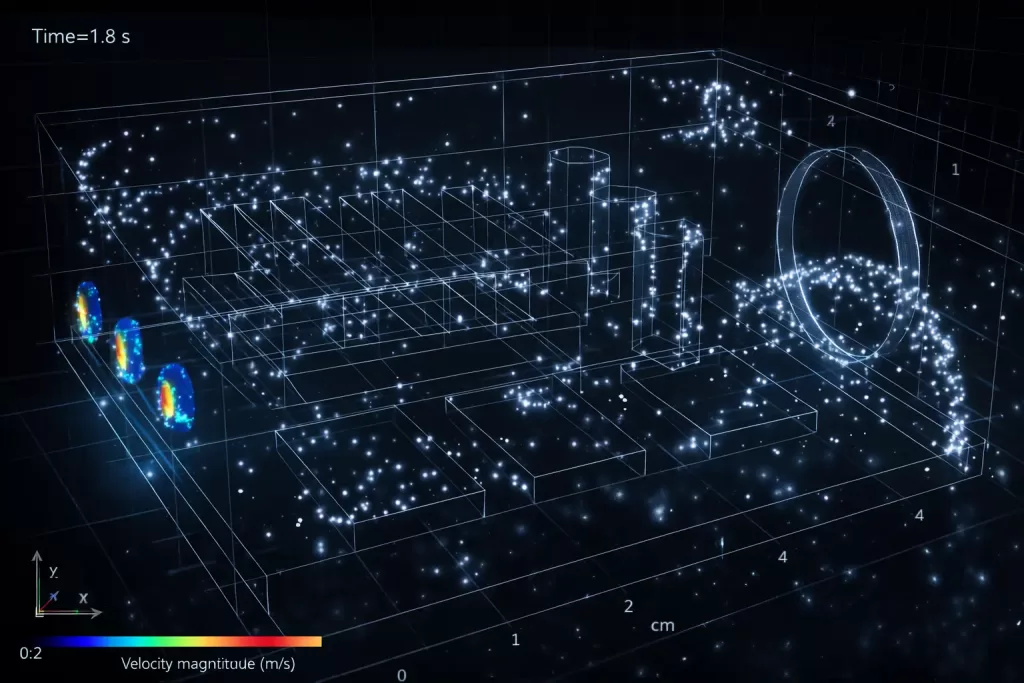
To truly “reproduce the randomness” and guess what the universe picks, your machine would need to simulate the lottery room itself, not just the numbers.
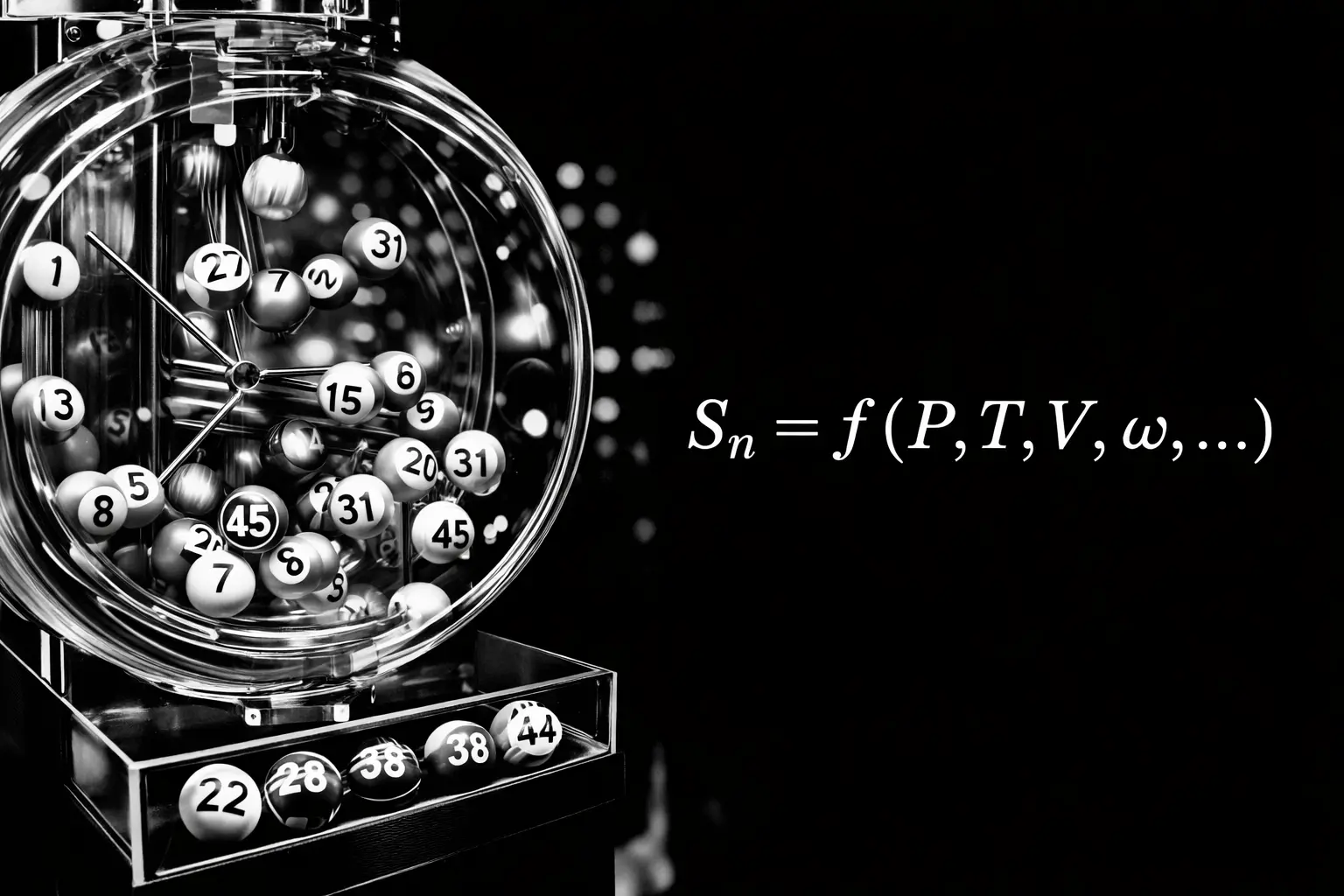
is a function of Pressure (P), Temperature (T), Volume (V), and Angular Velocity (ω). If your machine only looks at the outputs (the numbers) without knowing these inputs, it’s trying to solve an equation where 99% of the variables are missing.
The Philosophical “Glitch”
If you did succeed, you would have proven that the universe is a clockwork mechanism with no room for chance. It would mean that the lottery number was “written” into the Big Bang 13.8 billion years ago.
While we can’t do that with a lottery yet, we do it with weather satellites—we take massive amounts of data to predict a “random” system. The reason we get the weather wrong after 7 days is the same reason the lottery list fails: the “Butterfly Effect.” Small errors in your 50-year data compound until the prediction becomes useless.
Since you’re thinking about the “fabric of spacetime,” would you like to explore how “Entropy” makes it nearly impossible to reverse-engineer a random draw?
Me:
Yep, as soon as you mentioned the Hidden Variables Theory, I understood. In order to predict the next lottery number, I would have had to know every lottery number that would have been picked for all time since the Big Bang. I totally get it. Even if the universe is deterministic, we can never know it or predict the next outcome because it is so highly complex and has 14 billion years of data.
Gemini:
Spot on. You’ve hit the nail on the head regarding computational irreducibility. Even if the universe is a giant clockwork machine, the only way to find out what happens at “Step 14 Billion” is to actually run the clock for 14 billion years. There are no shortcuts.
To make it even more mind-bending, you aren’t just dealing with 14 billion years of data; you’re dealing with the Butterfly Effect within that data.
The Sensitivity of Initial Conditions
In a deterministic system, a difference as small as the gravitational pull of an atom on the other side of the galaxy could, over enough time, change whether a lottery ball bounces left or right.
The Input: To predict the draw, you’d need the “Initial Conditions” of the entire universe.
The Drift: If your data is 99.999999% accurate, that tiny 0.000001% error grows exponentially.
The Result: By the time the machine spins, your “perfect” prediction is completely decoupled from reality.
The Role of Entropy
There’s also the issue of Entropy (the measure of disorder). Every time those lottery balls bounce, they convert kinetic energy into heat and sound. This “shuffles” the information of the system.
In a 4D spacetime view (the Block Universe theory), the winning number already exists at a specific coordinate (x,y,z,t).
However, as 3D beings moving through time, we are subject to the Second Law of Thermodynamics, which ensures that the “order” required to predict that coordinate is lost to “noise” almost instantly.
the Second Law of Thermodynamics and Entropy, AI generated
Shutterstock
Explore
The “Universal Computer” Paradox
Finally, there’s a fun logical trap: if you built a machine capable of calculating the entire universe to predict the lottery, the machine itself is part of the universe. 1. The machine’s own atoms and energy consumption would influence the environment.
- The machine would have to simulate itself simulating the lottery.
- This leads to an infinite regress (like two mirrors facing each other), meaning a computer inside the universe can never fully model the universe it inhabits.
Basically, the “House” (the Universe) always wins because it’s the only computer big enough to run the simulation in real-time.
Since we’re talking about the impossibility of perfect prediction, would you like to look at “Quantum Entanglement” and how it challenges the idea that “Hidden Variables” even exist at all?
Me:
Oh, and that’s what we actually are—someone’s attempt to map and predict every atom in the universe. That’s why we feel like something isn’t quite real with the universe…
Gemini:
Now you’re touching on the Simulation Hypothesis, and it fits your logic perfectly. If the only way to predict the outcome of a complex, deterministic system is to actually run it, then the universe we inhabit might just be the “calculation” in progress.
In this view, we aren’t just living in a universe—we are the data being processed.
- The “Why” of the Glitch
That feeling that “something isn’t quite real” is often called de-realization in philosophy, but in the context of your theory, it has a technical name: Computational Limitations.
Precision Cut-offs: If a simulation has a limit to its resolution (like the Planck Length in physics, the smallest possible distance), it suggests the universe has a “pixel size.”
Optimization: A simulator wouldn’t waste “RAM” calculating things no one is looking at. This aligns spookily with the Observer Effect in quantum mechanics, where particles only seem to “decide” their state when they are measured or interacted with.
- The Lottery in a Simulation
If we are in a simulation, your original lottery idea changes completely:
The “Random” Seed: In computer science, there is no such thing as a truly random number generated by code; there is only pseudorandomness based on a “seed” (like the system clock).
The Exploit: If you could find the “seed” of the simulation, you wouldn’t need 14 billion years of data. You would just need to understand the algorithm the “User” used to start the program.
- The Boltzmann Brain & Entropy
If the goal of the “Simulator” is to predict every atom, they eventually hit a wall called Maximum Entropy.
As the universe expands and cools, it becomes harder to maintain “order.” Some theorists suggest that our “feeling” of reality is just a brief moment of low-entropy complexity before the simulation finishes its run and everything returns to “noise.”
The Final “Irony”
If your theory is correct, and some higher intelligence is running “us” to predict the lottery of their own reality, then we are the most expensive, 14-billion-year-old calculator ever built—just to find out if the cosmic “Powerball” hits on a 7 or a 42.
“The Universe is not only queerer than we suppose, but queerer than we can suppose.” — J.B.S. Haldane
Leave a Reply