“I’ve always believed in karma—that what you give to the world is what you get back. Lately, I’ve started to feel something deeper. A sense of direction. A calling. That’s when I began to understand the idea of dharma.”
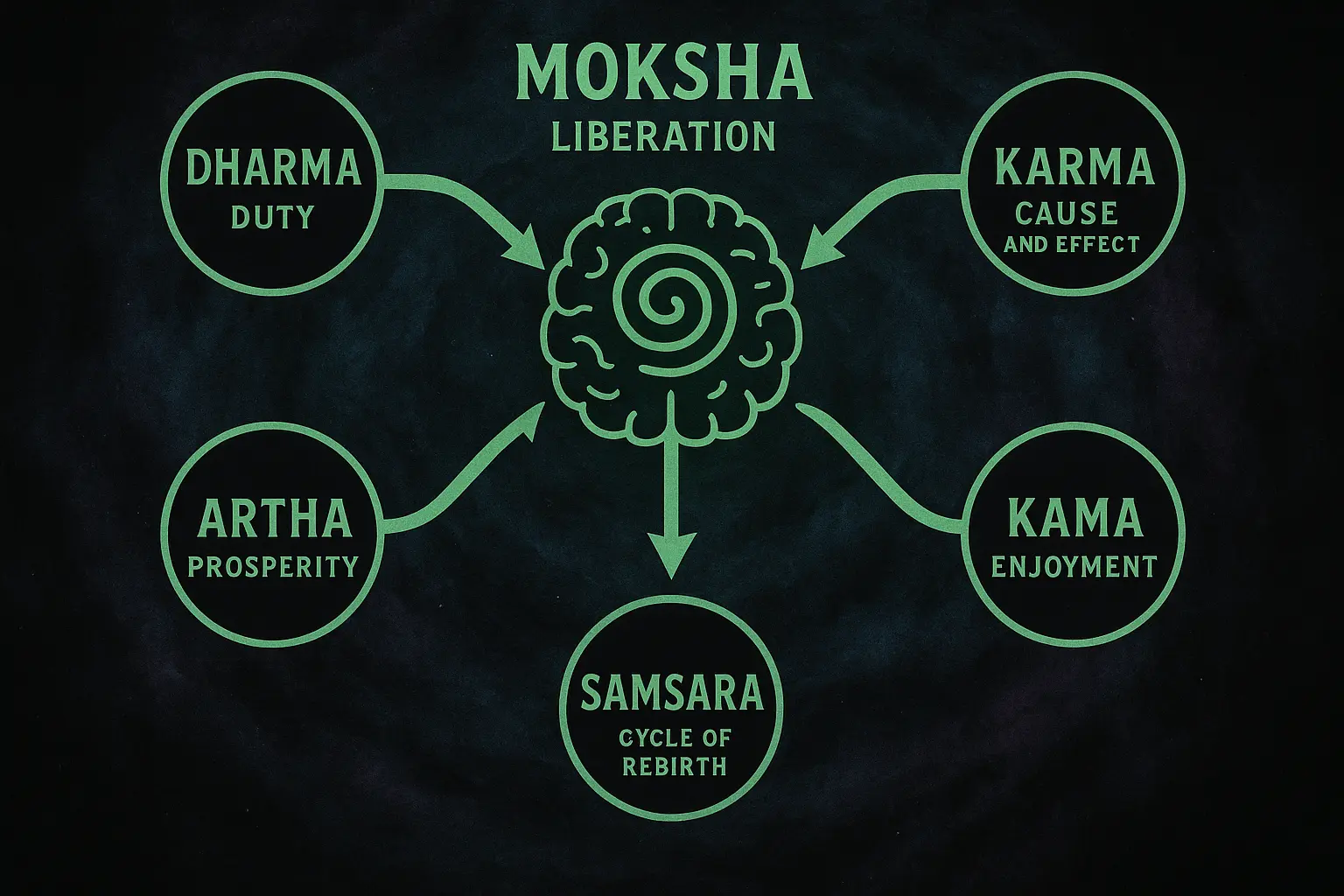
In recent months, I’ve been drawn to ancient philosophical ideas—not out of a desire to seem wise or spiritual, but because these ideas simply make sense. They help me understand not only the universe but also myself. The more I explore, the more I see how these concepts—dharma, karma, artha, kama, and moksha—can guide a life filled with meaning, peace, and progress.
This post is a map—not of a place, but of the inner terrain of the soul.
🧭 Dharma: Living in Alignment with Your Truth
Dharma is a Sanskrit word that refers to your personal path—your calling, your role, and your deeper purpose in life. It’s not necessarily a career or a job, but something more essential: the reason you’re here.
For some, it’s raising a family. For others, it’s building, teaching, healing, creating, or even asking the big questions. For me, it’s writing, sharing thoughts that might help others, and exploring consciousness with openness and curiosity.
When you’re in touch with your dharma, life feels meaningful—even during the hard times. You’re not just surviving. You’re becoming.
🔁 Karma: The Energy of Action and Reaction
Karma is the law of cause and effect. Every action—big or small—creates an impact. That energy doesn’t just disappear. It echoes through the world, and often, it returns to you.
This isn’t about punishment or reward—it’s about balance. If you offer kindness, support, and honesty, those qualities tend to return to you, even in unexpected ways. If you spread negativity, that can also ripple back.
From a spiritual point of view, and even a scientific one (think Newton’s Third Law), karma reminds us that everything we do matters.
Karma teaches that we are not separate from the world. We are part of a continuous flow of energy, creation, and consequence.
💰 Artha: Creating Stability and Prosperity
Artha represents wealth—not just money, but the resources and structure we need to live well. It includes financial health, career success, and the ability to support ourselves and others.
In many spiritual traditions, wealth is not seen as evil. It’s how it’s earned and what it’s used for that matters. Wealth gained through honest means, aligned with your dharma, can help you fulfill your higher purpose.
Right now, my artha is a work in progress. But I’ve learned that spiritual awareness and financial success don’t have to be opposites. In fact, they can support each other.
Artha asks: How can I live in the world, and thrive, without losing who I am?
❤️ Kama: Seeking Joy and Connection
Kama is the pursuit of pleasure—not just physical, but emotional, creative, and spiritual. It’s about joy, beauty, love, and all the small moments that make life rich and worthwhile.
Music. Friendship. A good meal. A shared laugh. A deep conversation. These are all expressions of kama.
It’s easy to think that pleasure is selfish. But when it’s part of a balanced life, it becomes sacred. Joy is not something to feel guilty about—it’s something to honor.
Kama reminds us that life is meant to be experienced—not just endured.
☀️ Moksha: The Goal of Inner Freedom
Moksha is the ultimate aim in many Eastern traditions: liberation. It’s freedom from suffering, ego, and the endless cycle of craving and reaction. It’s not something you achieve in one moment, but something you move toward with every act of awareness.
Moksha doesn’t require you to leave the world or become a monk. Sometimes, it’s just a moment of deep peace. A feeling that everything is okay. That you are enough. That life is beautiful, even in its complexity.
Moksha is not escape—it’s awakening.
🔷 The Vibe Map: A Spiritual Framework for Everyday Life
| Sanskrit Word | What It Means | How It Shows Up in Life |
|---|---|---|
| Dharma | Purpose, duty, natural path | Feeling connected to something meaningful. Doing what feels “right” for your soul. |
| Karma | Cause and effect | Knowing that every thought, word, and action creates a ripple—positive or negative. |
| Artha | Prosperity and stability | Building a life with the resources and tools you need to thrive. |
| Kama | Joy, love, and beauty | Enjoying life’s pleasures in a way that nourishes your spirit. |
| Moksha | Liberation and peace | Finding moments of stillness, surrender, and deep spiritual freedom. |
🌿 You Don’t Need to Be Perfect to Be on the Path
What I love about this framework is that it’s not rigid. It doesn’t demand perfection. It simply invites awareness. Whether you’re just beginning your spiritual path or you’ve been walking it for a while, you’re allowed to grow at your own pace.
You don’t need to be a saint to live with dharma. You don’t need to have perfect karma. You don’t need to reject money or desire. You just need to move with intention—and return to your center when you stray.
The journey itself is sacred. And if you’re on the path, in any way at all—you’re already doing better than you think.

Related reads:
Leave a Reply